spacer spacer
spacer
spacer spacer spacer spacer
spacer
spacer
spacer spacer spacer spacer spacer spacer spacer spacer spacer spacer spacer spacer
spacer
spacer
spacer
spacer  
spacer

Why does SDSU need to update its Campus Master Plan?

How is SDSU maximizing the use of existing resources to help meet increased demand?


What is included in the Campus Master Plan Revision?

How will the increased demand for student housing be met?

Why is SDSU proposing to build faculty housing at Adobe Falls?

What do the plans for Adobe Falls include?

Will SDSU propose mitigation for off-site traffic impacts resulting from the Campus Master Plan? ?

How will parking needs be met for the increased number of students?

If this project is approved by the CSU Board of Trustees, when will construction start?

What opportunities will there be for the community to provide input on the Campus Master Plan Revision?


Why does SDSU need to update its Campus Master Plan?
Over the course of the next decade, the demand for higher education in the state will grow tremendously. SDSU is no exception –  the university received more than 58,000 applications for almost 9,300 available spots for the Fall 2007 term – a 9% increase over last year. In order to better serve the region and state, SDSU must look to the future to plan how it will accommodate this growth. The Campus Master Plan is the blueprint that guides the growth and development of the campus over the next 20 years, and a Revision to this plan is needed in order to plan for future facilities to accommodate student growth. An updated Campus Master Plan is also necessary for the campus to apply for and receive new capital funding from California State University (CSU).

Back to Top

How is SDSU maximizing the use of existing resources to help meet increased demand?
A number of measures are proposed to help meet SDSU's fast-growing demand. These measures include:

  • Increasing summer enrollment
  • Developing off-campus centers, where appropriate
  • Expanding the use of academic technologies, such as web-based instruction

Even with the implementation of these measures, however, SDSU will still experience enrollment demand well in excess of its current capacity.

Back to Top

What is included in the Campus Master Plan Revision?
The Campus Master Plan Revision is intended to increase the university's capacity to serve the higher education needs of the region and state. In order to help accommodate the projected increase in enrollment demand and fulfill the CSU policy of guaranteeing admission to qualified applicants in California , the plan proposes an increase in student enrollment capacity to 35,000 full-time equivalent students (FTES). (The number of FTES is calculated by dividing the number of units a student is taking by 15. For example, a student taking 12 units would constitute 0.8 FTES. Because SDSU has both full and part-time students, the number of students on campus is often higher than the number of FTES).

The project also includes facilities that will help serve the increased number of students:

  • Alvarado Campus will house future classroom and support facilities.
  • Housing for an additional 2,796 students will be provided on campus, which will nearly double the existing supply of student housing on campus.
  • Adobe Falls, the site for a range of 172-348 affordable, high-quality homes for SDSU faculty and staff (the final number depends on whether alternate access to the site can be secured).
  • Alvarado Hotel proposes up to 120 rooms and suites to provide nearby accommodations for visitors to the university.
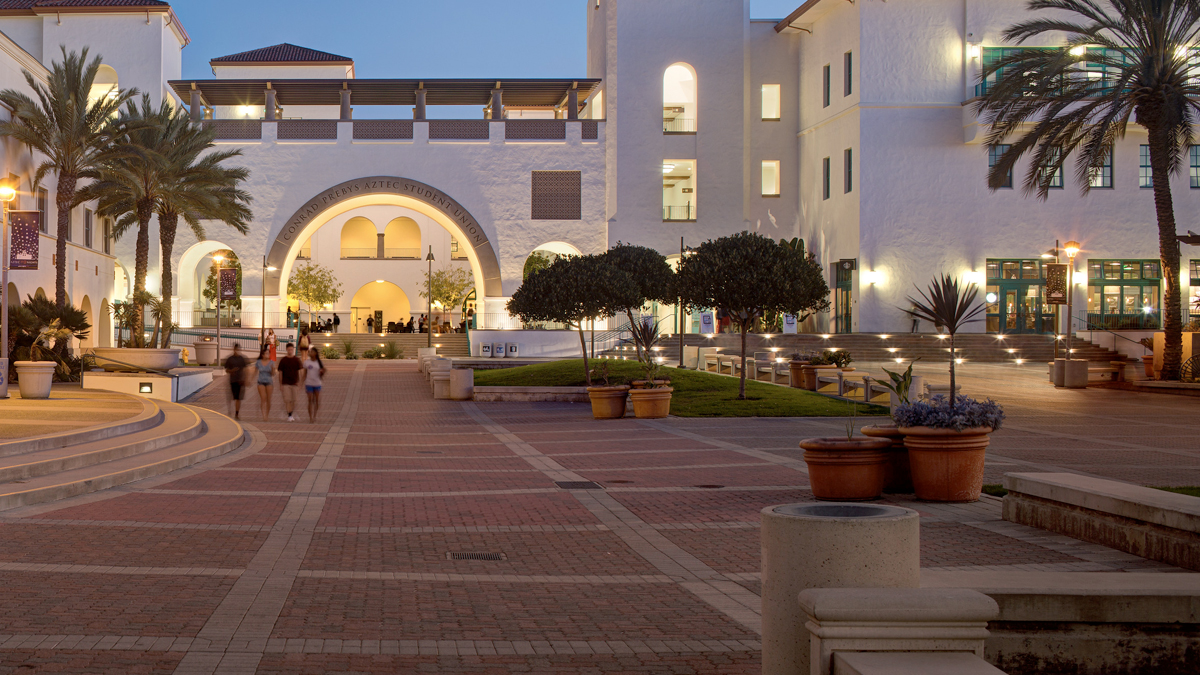
  • An expansion and renovation of Aztec Center, the existing student union building, will provide more space for student services.
  • A new university conference center will provide meeting space for conferences and symposia.

Back to Top

How will the increased demand for student housing be met?
The Campus Master Plan Revision includes housing for an additional 2,796 students, which will nearly double the amount of student housing on campus. In addition to student housing, the university manages 1,720 beds of student housing within walking distance to campus, and this number is expected to double by 2025. This would bring the total number of SDSU-controlled student beds to nearly 10,000 by 2025. This will enable SDSU to house 100% of its freshman and 94% of its sophomores in university-managed housing. SDSU is also working with private developers to provide even more student housing near campus and around trolley stations.

Back to Top

Why is SDSU proposing to build faculty housing at Adobe Falls?
SDSU is significantly challenged in recruiting new faculty and staff members due to the high cost of housing in San Diego . In order to meet the growing demand for higher education, SDSU needs to hire new faculty and retain existing faculty and staff. Providing a more affordable housing option close to campus will help SDSU in its recruitment and retention efforts.

Back to Top

What do the plans for Adobe Falls include?
In the 2005 plan, 540 homes were proposed for Adobe Falls. As a result of further study and input from the community the number of homes proposed at Adobe Falls has been substantially reduced from the original plan.

This project will be constructed in phases over the next several years and was carefully designed to ensure that there will be no significant impacts on residential streets in the surrounding community. If no alternate access can be provided to the site, a maximum of 172 homes are proposed – a more than 68 percent reduction from the original proposal. If alternate access can be provided, up to 348 homes could be developed on the site.

In addition to providing affordable homes for faculty and staff, the Adobe Falls project will substantially improve the surrounding environment. More than 9.5 acres of wetlands and native habitat will be preserved and enhanced as part of the project. Trails will also be incorporated to allow neighbors to access the falls and open space areas.

Back to Top

Will SDSU propose mitigation for off-site traffic impacts resulting from the Campus Master Plan?
The recent California Supreme Court decision in City of Marina v. Board of Trustees of the California State University requires that CSU seek funding for its fair-share of the costs of off-site transportation and improvements made necessary by university development. This decision applies to the entire California State University system, including San Diego State University. As a result, the revised EIR for SDSU's Campus Master Plan Revision will address and analyze fair share obligations for mitigations needed as a result of the plan. The university is currently working with the appropriate agencies to discuss these fair share obligations. Once they are determined, a request for funding must be made to the state legislature. The CSU's ability to mitigate the project's effects is ultimately subject to legislative control. If the legislature does not fund the mitigations, the Trustees have the authority to adopt a statement of overriding considerations and proceed with the Master Plan.

Back to Top

How will parking needs be met for the increased number of students?
Parking will be incorporated into new buildings as needed, and stand-alone structures will be constructed based on specific demand. Parking proposed in the Master Plan includes a parking structure for approximately 2,000 cars at Alvarado Campus.

Back to Top

If this project is approved by the CSU Board of Trustees, when will construction start?
Once the master plan is approved work will begin on several elements of the plan. The following elements of the plan are being analyzed at the “project level,” meaning that once approved they can proceed to construction once funding is identified:

  • Student Union building (funding is in place and construction can move forward once the plan is approved)
  • Adobe Falls upper village
  • College of Education building at Alvarado Campus
  • Student housing
  • Alvarado Hotel
The remaining elements, including Adobe Falls lower village and the remainder of Alvarado Campus, are being analyzed at the “program level,” which means that they will require further public and environmental review, and a subsequent action by the Board of Trustees, before they can be constructed.

Back to Top

What opportunities will there be for the community to provide input on the Campus Master Plan Revision?
For the last several months SDSU has sought extensive input from neighboring residents, campus stakeholders and other important organizations. As a result of this input, the university has made a number of significant changes to the plan.

June 13, 2007 marked the beginning of the 45-day public review and comment period for the draft Environmental Impact Report for the plan. The public is invited to review the Draft EIR and offer written comments to SDSU through July 27, 2007.

SDSU representatives will continue to work closely with neighboring community groups, including the College Area Community Council, Navajo Community Planners, Del Cerro Action Council and others.

Back to Top


spacer